No tool makes a store a million dollars. But when you look at how online brands grow from a side project to seven figures in yearly sales, the same pattern shows up again and again: they stop losing the customers who were already trying to buy. On social media, those customers are easy to see. They comment "price?", they send a DM about sizes, they leave a checkout half finished, they ask when something is back in stock. Every one of them is a sale that happens or doesn't depending on how fast and how well someone answers.
This playbook shows where social sales leak, the automations that close each leak, and the order to build them in.
The revenue math that matters
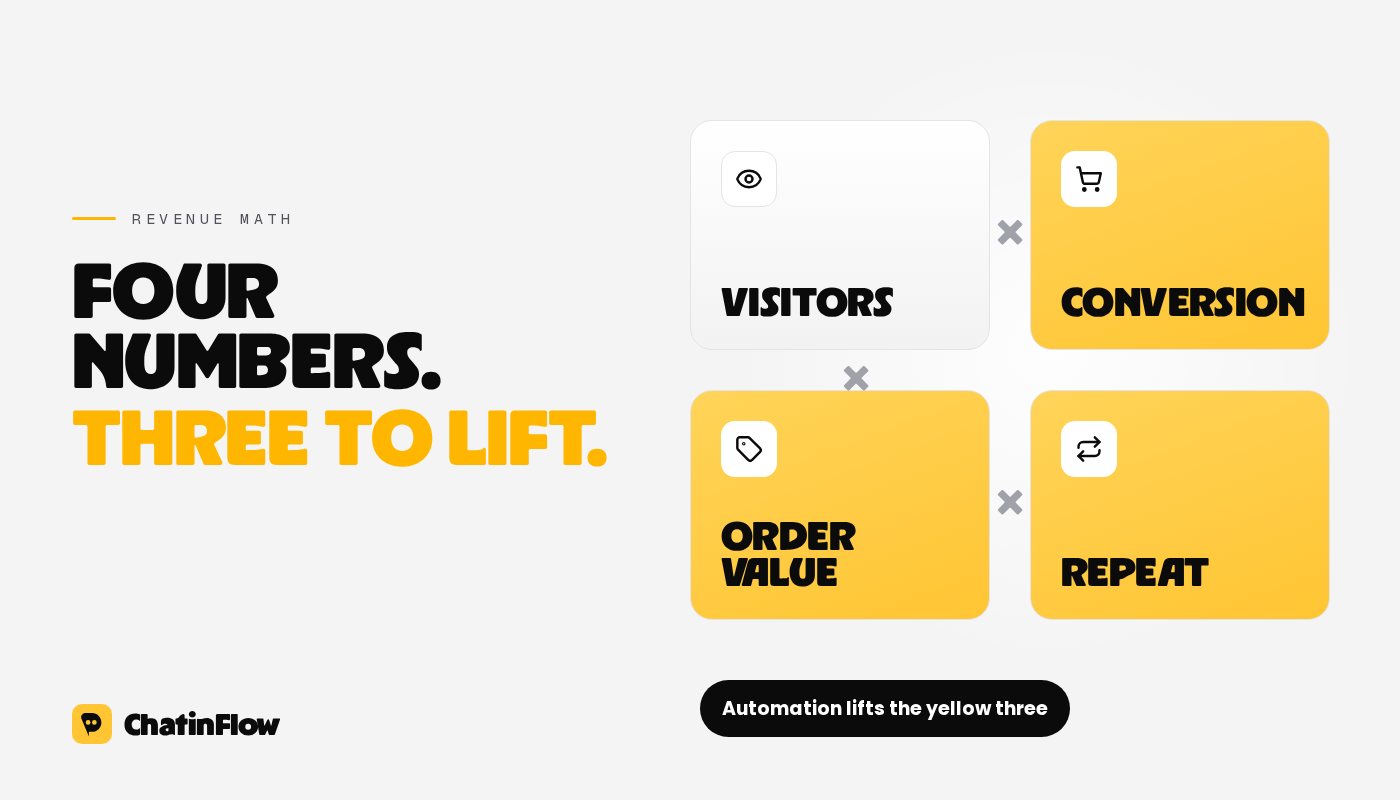
Online revenue comes down to four numbers:
- Visitors: how many people see your products.
- Conversion: how many of them buy.
- Order value: how much each order is worth.
- Repeat purchases: how often a customer comes back.
To see what your goal means, divide it by your average order value: that is the number of orders you need in a year. Most brands try to grow by buying more visitors with ads. Social automation works on the other three: it turns more of the people you already reach into buyers, raises the order value with the right suggestion at the right time, and brings customers back.
Leak 1: "Price?" comments nobody answers
Every product post gets comments like "price?", "link?", "do you ship to Canada?". Answered in the comments, they get lost; answered hours later in DMs, the person has moved on.
The fix: a comment keyword on product posts. The viewer comments LINK or PRICE and gets the product, the price and a buy link in their DMs within seconds, while a public reply under the comment tells everyone else how to get it. In ChatinFlow, an automation tied to the post answers only that post's comments, so each product gets its own link. Setup: comment-to-DM guide.
Leak 2: questions before the purchase
"Is this true to size?", "Does it come in black?", "How long is delivery?". A customer with an unanswered question rarely buys.
The fix: answer the common questions instantly and send the rest to a person.
- Buttons for the top questions: sizing, delivery, returns.
- Keywords for specific words such as "size" or "shipping".
- An AI agent that answers from the sources you give it (your product pages, your shipping policy) and hands the chat to your team when it doesn't know. In ChatinFlow it runs on your own AI key.
Leak 3: abandoned checkouts
Shoppers start checkout, type their email or phone, and leave. Some were comparing, some were interrupted, some had a question.
The fix: a reminder that brings them back to their filled cart. ChatinFlow's Cart abandoned trigger fires when a shopper who typed an email or phone at your Shopify checkout leaves for an hour without ordering, and the flow stops on its own if they order later. Send the reminder by email, or by WhatsApp to shoppers who agreed to be contacted; outside the 24-hour window, WhatsApp only allows approved message templates.
Keep it helpful, not pushy: "Your cart is saved here. Any question about sizing? Just reply." A discount on the first reminder teaches customers to abandon carts on purpose.
Leak 4: ads that send people to a page they leave
Ads that open a product page lose many people on mobile. Ads that open a chat ("Send message" ads to Instagram, Messenger or WhatsApp) start a conversation instead, and a conversation can answer the question that stopped the sale.
The fix: a flow that starts when someone arrives from the ad: greet them, show the product from the ad, ask one question (size, color, budget), and send the buy link or a person.
Leak 5: "When is it back in stock?"
Every sold-out product is a list of people who wanted it.
The fix: a RESTOCK keyword on the sold-out post. Tag everyone who comments, collect their email or WhatsApp opt-in in the same chat, and message them the day it is back. On Instagram you can't message someone days later unless they write again, which is why the email or WhatsApp opt-in matters.
Leak 6: customers who buy once and disappear
The cheapest sale is to someone who already bought.
The fix: a post-purchase flow on the Store order paid trigger (Shopify or WooCommerce):
- A thank-you with care or usage tips that make the product work better.
- A satisfaction question once the order has arrived, by email or by WhatsApp with an approved template, so you hear about problems before they become bad reviews.
- A reason to come back: a matching product, a refill reminder, or a one-time code for the next order with ChatinFlow's Give a one-time code step.
- A "bring a friend" offer for happy customers.
Growth levers on top
Once the leaks are closed, these multiply what you already have:
- Giveaways that bring comments and new followers, run by Instagram's promotion rules: see Instagram giveaway rules.
- Product drops on Instagram Live, where every viewer who comments the keyword gets the link while you are still showing the product: see Live comments to DM.
- Broadcasts to opted-in WhatsApp customers for launches and restocks, with templates Meta approved.
- Limited editions with the Limited spots step, which lets the first buyers through and sends the rest to a waitlist.
The order to build it in
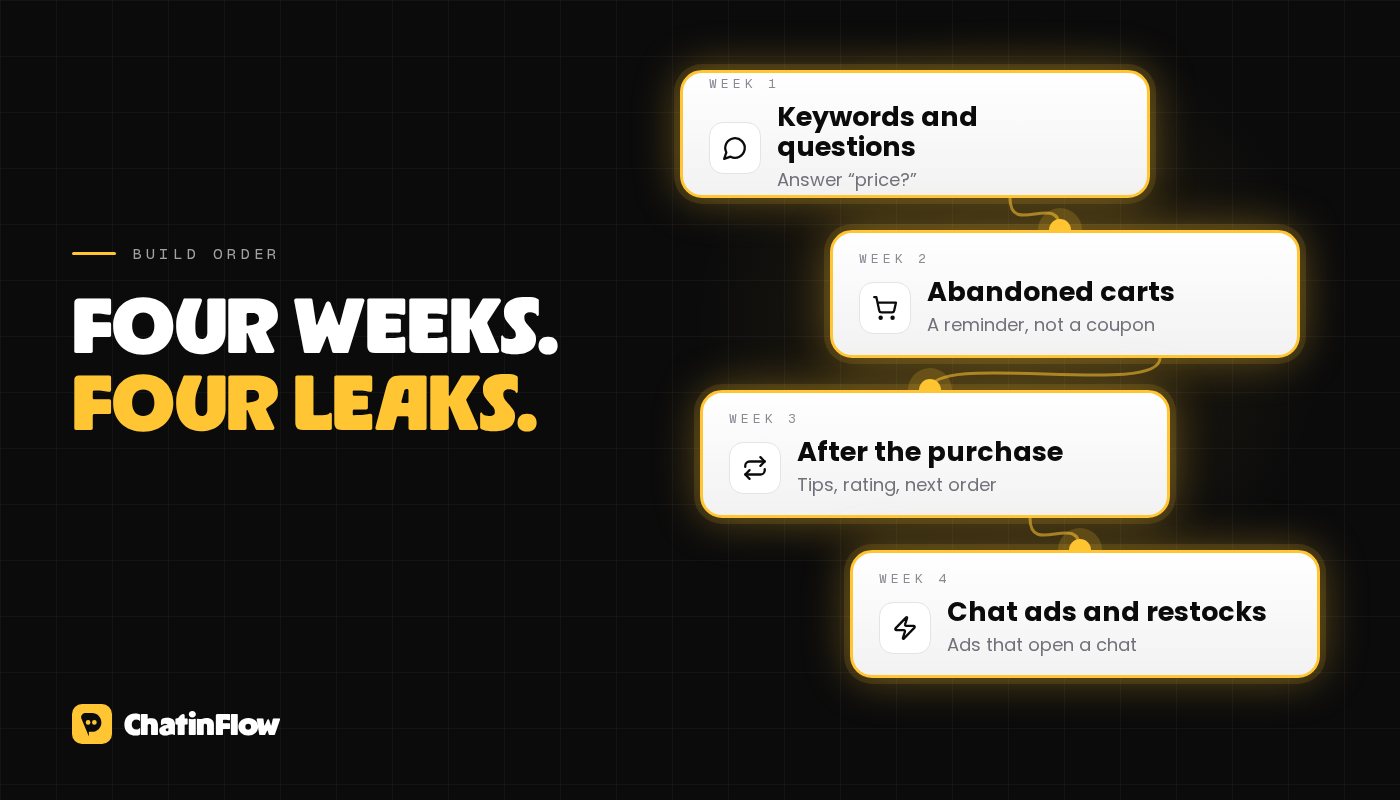
Don't build everything at once. Start where the most money leaks today:
- Week 1: comment keywords on your best-selling product posts, and buttons for the top three questions.
- Week 2: abandoned cart reminders by email and WhatsApp.
- Week 3: the post-purchase flow with the satisfaction question.
- Week 4: chat ads, restock waitlists and a first giveaway.
Measure in money, not messages
For each automation, track what it earns, not how many messages it sends. In ChatinFlow, paid orders from your store count in your reports, and a Record a conversion step can count a sale with its value at any point in a flow. Compare each month: which posts, keywords and flows brought orders, and which only brought conversations.
A store doesn't reach seven figures because of one viral post. It gets there because every person who raises their hand gets an answer, a reason to buy and a reason to come back. Automation is how a small team does that for everyone, at any hour. The ChatinFlow for e-commerce page shows the tools in one place.
Sources
- Meta for Developers, Private Replies: one private reply per comment; follow-ups within 24 hours of the customer's response. Checked October 2026.
メールで
新しいフローを あなたの受信箱へ。
成果の出るフロー、新しいプレイブック、ChatinFlowの変更点をお届けします。スパムはなく、ワンタップで解除できます。
こちらもおすすめ
質問と回答
この記事について質問できます。ChatinFlow チームがここで回答します。
ChatinFlow チーム
まだ質問はありません。最初の質問をどうぞ。ここで回答します。