The small businesses getting the most out of AI in 2026 aren't the ones that replaced their team with a chatbot. They are the ones that handed AI the repetitive, language-heavy work (answering the same questions, collecting details, drafting replies, summarizing) and kept people on the decisions, the exceptions and the relationships. Customers get faster answers; the team gets its time back for the conversations that need a human.
This guide shows how to decide what to automate, where AI beats simple rules (and where it doesn't), how to set it up safely, and how to tell whether it is working.
Start with a list, not a tool
For one week, write down the tasks that eat your team's time. For each, note how often it happens and whether it follows a pattern. A typical list for a small business:
- Answering the same questions about prices, hours, delivery and availability.
- Collecting details from new leads: what they need, their budget, their timing.
- Booking, moving and reminding about appointments.
- Following up on quotes and unfinished orders.
- Writing replies to messages that need some thought.
- Summarizing long conversations for whoever takes over.
The best candidates happen often, follow a pattern and cost little when they go slightly wrong. The worst candidates are rare, high-stakes or emotional: complaints, refunds outside policy, pricing exceptions.
Rules first, AI where the language varies
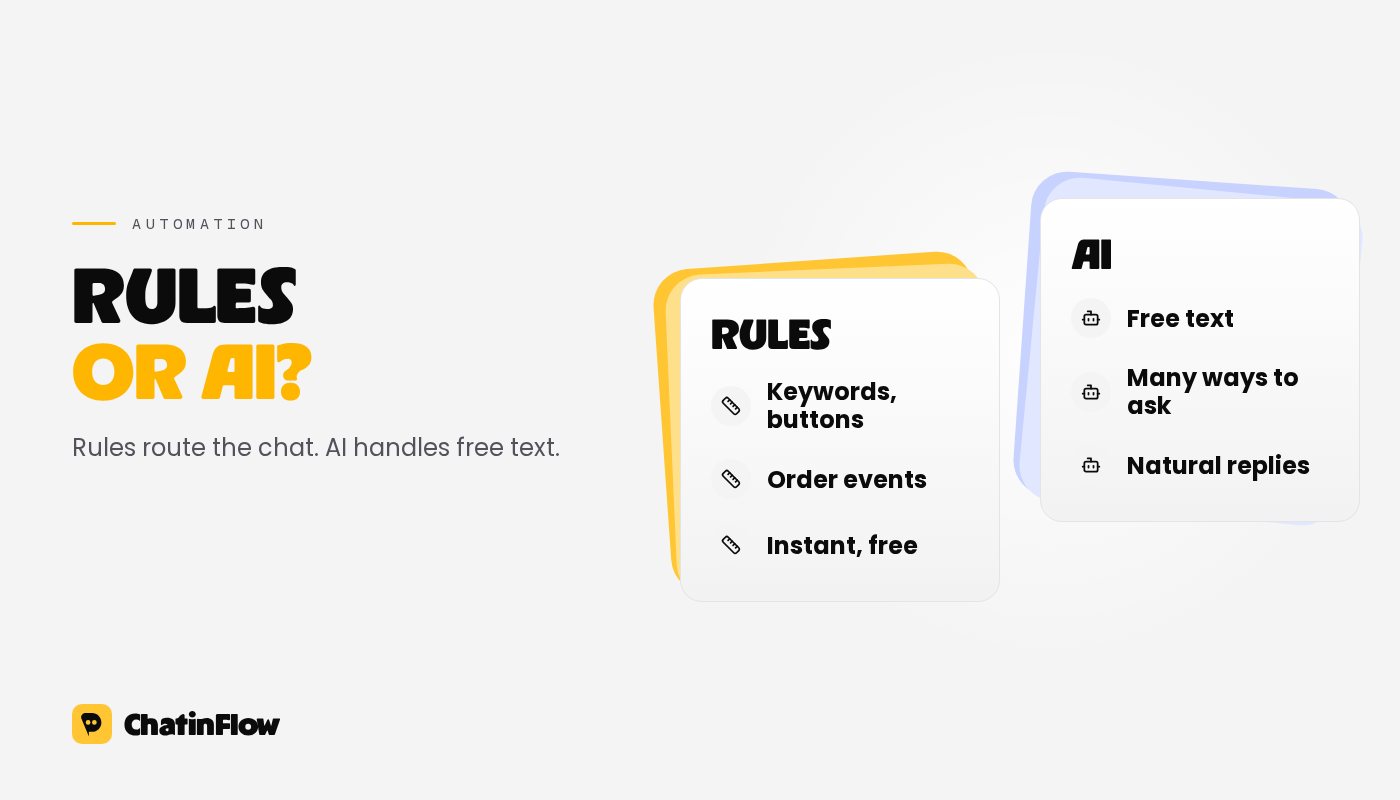
Not everything needs AI. A lot of automation is better done with plain rules, because rules are predictable, instant and free to run:
- Use rules when the input is predictable: a keyword, a button tap, a form field, an order event. "Someone comments PRICE, send the price list." "An order is paid, send the confirmation."
- Use AI when the input is free text that varies: questions asked in a hundred different ways, details buried in a long message, replies that need to sound natural.
Most good setups combine both: rules route the conversation, AI handles the parts where people write freely, and a person takes over when needed.
Where AI earns its place
Answering questions from your own information
An AI agent that answers from the information you give it (your website, your price list, your policies, a PDF) can handle a large share of routine questions at any hour. The key words are "your information": an AI answering from its general knowledge will confidently invent prices and policies.
In ChatinFlow, the AI agent step answers from the sources you add, remembers the conversation, and hands it to your team when it doesn't know. You can also run it only outside working hours, so your team answers during the day and the AI covers nights and weekends.
Collecting details in a natural conversation
Forms feel like work; a conversation doesn't. AI can ask for what you need (name, need, budget, date) the way a person would, and save the answers to the contact. ChatinFlow's Collect with AI step does this until it has the details you asked for.
Drafting replies for your team
For messages that need a human decision, AI can draft and the person can edit and send. In the ChatinFlow inbox, a teammate can ask AI to suggest or rewrite a reply before sending it.
Set it up safely
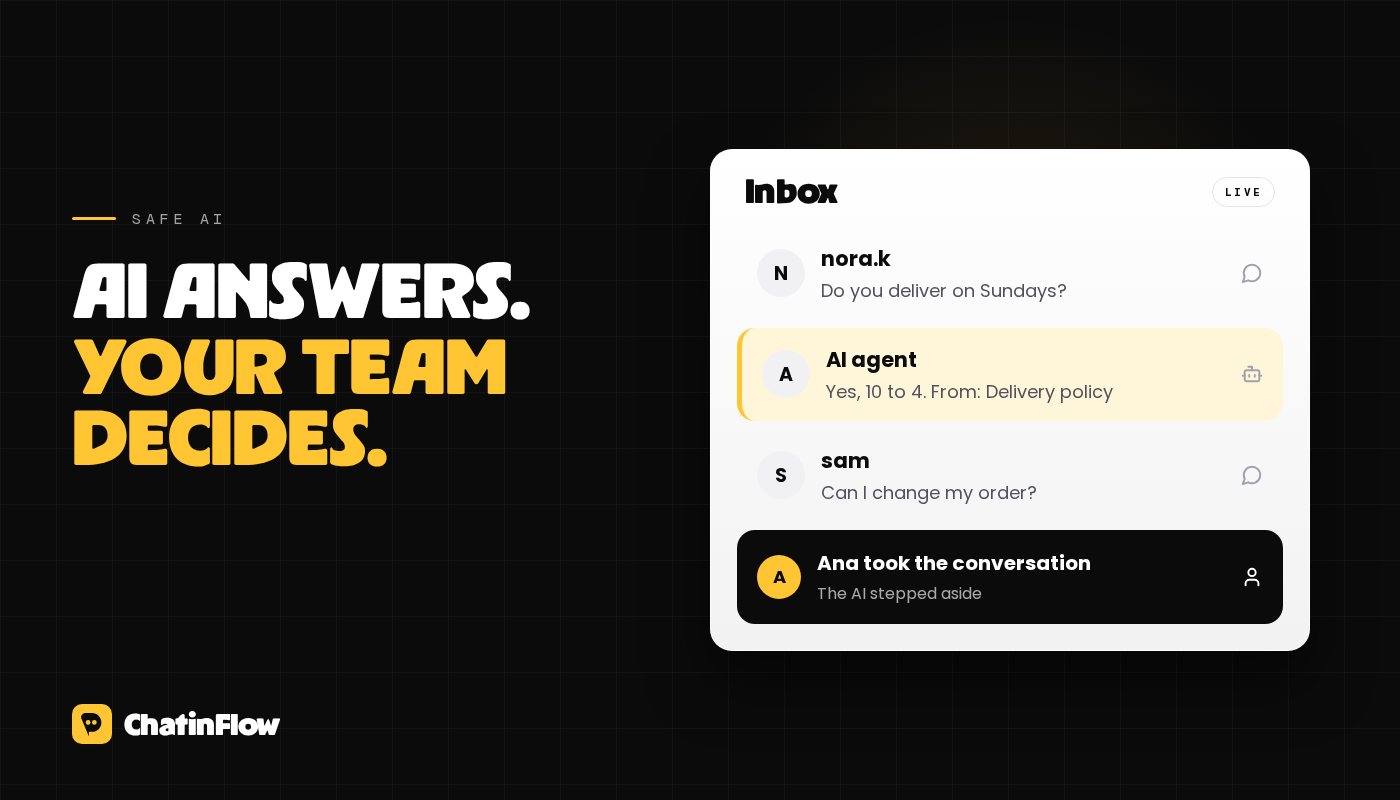
- Give it sources, not freedom. Limit answers to your own information, and tell it what to do when the answer isn't there: say so and hand over.
- Always have a handoff. Every AI conversation needs a path to a person, and the customer should be able to ask for one.
- Cap the cost. AI is billed by usage. In ChatinFlow, AI runs on your own key with OpenAI, Anthropic, Google or Azure, so it costs what the provider charges, and you can set daily and monthly spending limits per key.
- Mind the data. Don't send more personal information to an AI model than the task needs, and tell customers when they are talking to an automated assistant.
- Read the first conversations. For the first week or two, read what the AI said. You will find gaps in your sources and questions you never thought of.
Measure whether it works
Track before and after:
- First response time: how long customers wait for a first answer.
- Resolution without a person: the share of conversations the automation finished on its own, and whether those customers came back satisfied.
- Handoffs: how many conversations reached the team, and why. Frequent reasons are gaps to fill in your sources.
- Outcomes: bookings, sales and leads from automated conversations.
- Satisfaction: a short rating question at the end of a conversation tells you whether faster also means better.
If customers get faster answers, the team spends less time on repeats, and satisfaction holds, it is working. If satisfaction drops, look at what the AI says, not just how much it handles.
What to keep human
- Complaints and anything emotional.
- Decisions that cost money: refunds, exceptions, discounts outside the rules.
- Your best customers, who deserve a person.
- Anything where a wrong answer has legal or health consequences.
A one-month plan
- Week 1: list the repetitive tasks and pick the top two.
- Week 2: automate the first with rules (keywords, buttons, order events) and add an AI agent with your own sources for the questions rules can't catch.
- Week 3: add a handoff and a satisfaction question; read every AI conversation.
- Week 4: fix the gaps, measure response time and outcomes, and pick the next task.
AI doesn't replace knowing your customers. It gives you more time to do it. For the conversations that start on social media, read the comment-to-DM guide, and for the sales side, how to increase sales.
邮件订阅
新流程 直达你的收件箱。
好用的流程、新的玩法手册,以及 ChatinFlow 的更新。没有垃圾邮件,一键即可退订。
你可能也喜欢
问题与解答
关于这篇文章有疑问?ChatinFlow 团队在这里解答。
ChatinFlow 团队
还没有人提问。来问第一个问题吧,我们就在这里回答。