Your first 1,000 customers won't come from the same place as your next 100,000. At the start there is no brand, no reviews and no ad budget that pays back, so the methods that work are manual, personal and focused on one kind of customer. Founders who get there quickly almost always do the same thing: they go to their customers one by one, through one or two channels, and they treat every early customer as a source of learning, not just revenue.
This guide brings together what founders and investors have learned about that stage, and turns it into a plan you can start this week.
Do things that don't scale
Paul Graham, co-founder of Y Combinator, wrote the essay most founders read at this stage: "Do things that don't scale". His point is that startups take off because the founders make them take off, by hand. They recruit users one at a time, they onboard them personally, and they give each early customer an experience so good that it would be impossible to repeat at a large scale. That effort is what gets the first group of customers, and what teaches you what the product should become.
Pick one channel and go deep
Lenny Rachitsky studied how well-known consumer products found their first 1,000 users, from marketplaces to social apps. Two of his findings matter most:
- Most of them found their early users through a single strategy. A few used two or three; none succeeded with more.
- Most of those strategies meant going to users directly: in person, online, or through friends.
He also found that you need to define your target user narrowly before any tactic works. "Small businesses" is not a target; "independent hair salons with two to five chairs" is.
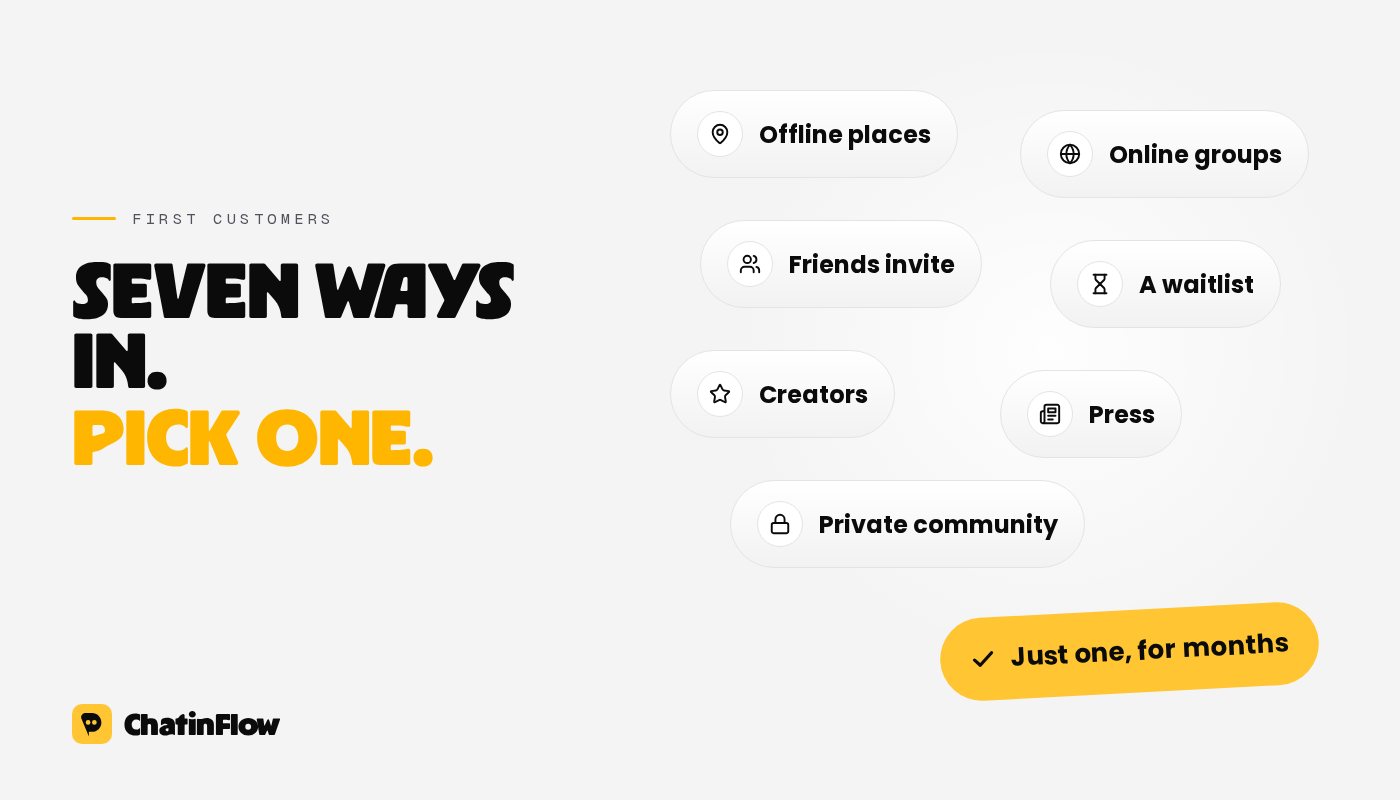
The strategies he describes are worth knowing:
- Go where your target customers already are, offline: events, shops, campuses, meetups.
- Go where they gather online: communities, groups, forums, the comment sections they read.
- Invite friends, and make it easy for customers to invite theirs.
- Create scarcity: a waitlist or limited spots that make joining feel like an opportunity.
- Work with creators your customers already follow.
- Get press in the outlets your customers read.
- Start in a private community and grow out from it.
Pick the one that fits your customer best, and give it all your attention for a few months before adding another.
Make every channel a conversation
At this stage, conversations beat campaigns. A message from a founder, answered in minutes, wins customers that an ad never would. Wherever your customers find you, make it easy to talk:
- Social media DMs. Comment keywords on your posts ("comment DEMO and I'll send you a walkthrough") start conversations with people who are already interested. See the comment-to-DM guide.
- WhatsApp and website chat for people who prefer them.
- Answer every message personally in the first months, even if a flow sends the first reply. What people ask is your best product research.
In ChatinFlow, all of these arrive in one inbox, a flow can answer the first questions and tag who asked what, and the free plan is enough to start on one channel.
Turn early customers into a growth engine
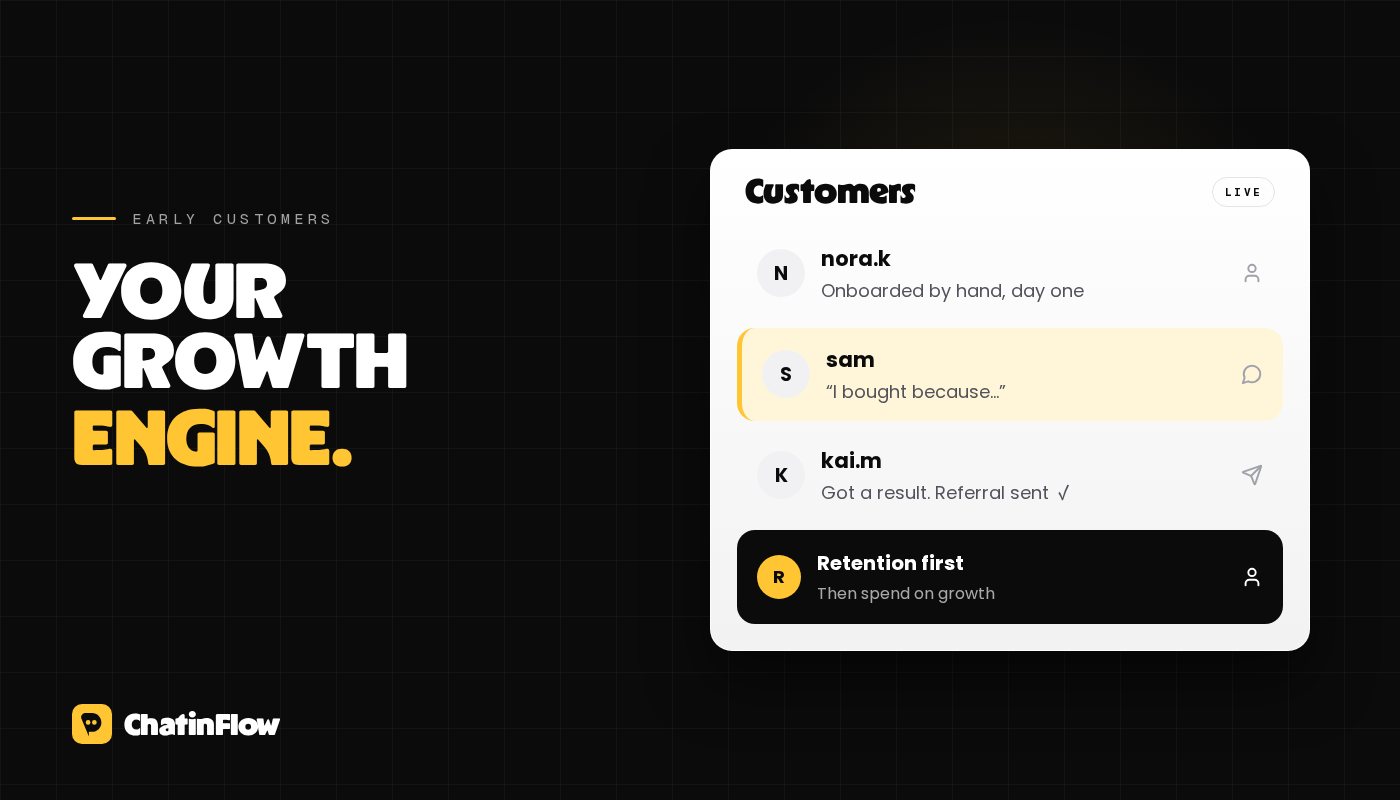
- Onboard them yourself. A call, a personal message, a setup done together. Customers who succeed in the first week stay and talk about you.
- Ask why they bought. The words they use are your marketing copy.
- Ask for referrals at the right moment, right after they get a result, with something for them and their friend.
- Build a waitlist for what's next. A keyword like WAITLIST on a post, plus a tag on everyone who joins, gives you a launch list before the launch.
- Collect emails, so you can reach everyone when you have news. See grow your email list from Instagram.
Watch retention before you scale
A thousand customers who leave after a month is not a business. Before you spend on growth, check that customers come back, keep paying or buy again. If they don't, the product or the target customer needs work first, and more marketing will only make the leak bigger.
Mistakes that slow the first 1,000
- Trying five channels at once and doing none of them well.
- Waiting for the product to be perfect before talking to customers.
- Targeting everyone, so no message feels written for anyone.
- Automating too early. Automate the first reply and the repetitive answers, but keep the conversations that teach you something personal.
- Ignoring the customers you already have in the rush to find new ones.
A four-week start
- Week 1: write down your target customer in one sentence and list where they spend time, online and offline.
- Week 2: pick one channel. Have twenty conversations with potential customers there.
- Week 3: onboard your first customers by hand and write down every question they ask.
- Week 4: add one way for happy customers to bring a friend, and one way for interested people to join a waitlist.
Then repeat, with the lessons from each month. The first 1,000 customers are slow. The next thousand are faster, because the first ones taught you what to say, where to say it and who to say it to. When you are ready to grow sales from there, read how to increase sales.
Sources
- Paul Graham, Do Things that Don't Scale (2013). Checked October 2026.
- Lenny Rachitsky, How the biggest consumer apps got their first 1,000 users. Checked October 2026.
邮件订阅
新流程 直达你的收件箱。
好用的流程、新的玩法手册,以及 ChatinFlow 的更新。没有垃圾邮件,一键即可退订。
你可能也喜欢

问题与解答
关于这篇文章有疑问?ChatinFlow 团队在这里解答。
ChatinFlow 团队
还没有人提问。来问第一个问题吧,我们就在这里回答。