The full guide
How to get more students for a language school: placement, trial lessons and enrolment from Instagram messages
Place new students by level and goal in the chat, book trial lessons in classes with places, enrol after the trial and keep students practicing between lessons.
"I want to learn Spanish before I move" is how most language students start, and it comes with the same questions every time: which level am I, which class fits, how much is it, can I try first. A school answers them dozens of times a week, usually while the teachers are teaching, and a student who waits a day for the answer signs up for an app instead. ChatinFlow asks those questions in the chat, places each student in a group or with a tutor by your rules, books a trial lesson in a class with free places, takes the course payment and reminds students before every class. This guide shows language schools and independent tutors how to place students by level without a phone call, fill trial lessons, enrol students after the trial and keep them coming after week three.
How language schools get students from Instagram
Language students search with a goal, not a level: moving abroad, an exam, a job interview, a partner's family. A school that answers the goal first wins the student. A placement flow:
- A student messages on Instagram, Messenger or your site chat with a goal and a language, often not knowing their level.
- The flow asks the language and the goal as taps: travel, work, an exam, moving, for fun.
- It asks the current level in plain words: complete beginner, I know the basics, I can hold a conversation, I'm fluent but rusty.
- It asks the format: a group class or one-to-one, in person or online.
- It offers the classes that fit, from your timetable, with a trial lesson.
How to place students by level without a test call
Placement calls take a teacher's time, and most students can place themselves with the right questions. Ask a few quick ones about what they can already do, and place them by your rules. If you use a written placement test, the flow sends its link too, and the result can be saved on the student.
Plain descriptions work better than labels like B1. "I can order food and ask directions, but conversations are hard" tells you more than a code the student doesn't understand.
Teachers stop starting the term with someone who belongs two levels up.
Book a trial lesson in two minutes
In Bookings, each group class can be a service with a number of places, such as eight students. Trial lessons are booked from your timetable with the class capacity respected: the student picks a trial in the matching group, the place is taken, and the confirmation goes out with the class link or the address and a link to change or cancel.
A reminder before the lesson reduces no-shows. On Instagram and Messenger, a business can write freely for 24 hours after the student's last message, so a trial booked for the next day is easy to remind; WhatsApp can carry reminders with a template Meta approved, and email, when enabled for your workspace, has no window.
Enrol students right after the trial
The moment after a good trial lesson is when students say yes. Right after the trial is marked complete, the student can enrol with one payment:
A Buy button with the course price opens Stripe or PayPal checkout, and you're told when it's paid. Instalment plans stay in your own billing system.
Keep students motivated between lessons
Students drop out in week three, when the excitement fades and the homework doesn't. A sequence sends a short tip or exercise each week, by email or in the chat, so students keep going between lessons and come back to class prepared:
- Week 1. Five words to use this week.
- Week 2. A two-minute listening exercise.
- Week 3. "You're doing great; here's what most students find hard now."
- Week 4. A phrase to try with a native speaker.
Telegram is a good home for practice messages: everyone who started your bot can get them at any time.
One-to-one lessons and exam preparation
Requests for interview practice, exam prep or presentations need the right teacher. A one-to-one path asks the goal and the timing, and the request is assigned to the teacher who covers it, with the goal already written down. The student hears back from a person, not a form. For tutors with set availability, a one-to-one service in Bookings lets the student pick a time straight away, from that teacher's free times.
Exam courses with fixed dates
Exam prep courses start on fixed dates and have a set number of places. A limited spots step gives places in order and tells everyone after the limit which course to aim for next. Save the exam date on the student, and a date rule can send a revision plan a set number of days before it.
Answers in the student's language
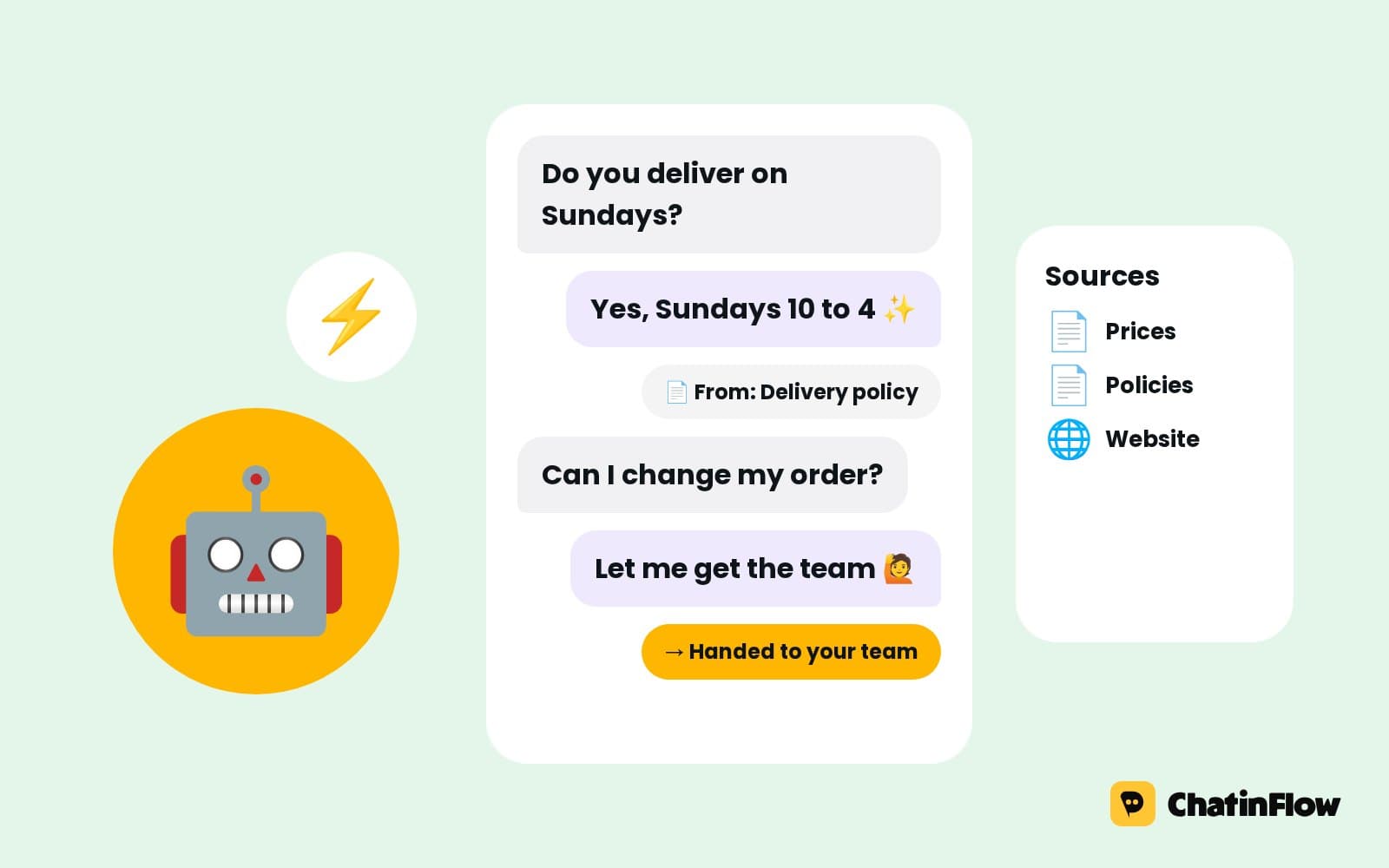
Language schools talk to students who don't yet speak the language they're learning. Write your answers in the languages you teach in, or connect your own AI key on a paid plan and let an AI step reply in the student's language, within the rules you set. A handover step sends anything the AI shouldn't answer to your team.
Questions every language school gets
Write each answer once:
- "How long until I can hold a conversation?" Your honest answer.
- "Are classes online or in person?"
- "How big are the groups?"
- "Who are the teachers?"
- "Do you give certificates?"
- "What if I miss a class?"
Corporate language training
Companies buy courses for their teams. A path for companies asks the number of learners, the language, the levels and the goal, opens a deal for your sales person and books a call. Save the company name on the contact, and every learner from that company can be tagged.
Instagram content that brings language students
- One phrase a day. Short, useful, with "Comment LEARN for a free trial".
- Mistakes natives notice, with humor.
- Student stories, with permission: "From zero to a job interview in Spanish".
- Meet the teachers.
- Course start dates, with "DM COURSE".
Language school message templates
Measure placement, trials and enrolments
- Trials booked per week, by language and level.
- Trials attended.
- Enrolments after a trial, recorded with a conversion step when the course is paid.
- Retention, from students who rebook the next course.
A group with many trials and few enrolments needs a look at the trial lesson.
Children's language classes: talking to parents
Many schools teach children, and the questions come from parents: "Is there a class for a 7 year old?", "Are the teachers native speakers?", "Can I sit in?". A parent path asks the child's age first, offers the classes for that age group and books a trial into one with free places. The confirmation goes to the parent, with what the child should bring.
Online and in-person classes side by side
Schools that teach both should ask the format early. Online students get the class link in the confirmation and the reminder; in-person students get the address and the room. Make online and in-person versions separate services, so their places and their timetables stay apart.
Refer a friend for language schools
Students who enjoy a class bring friends, especially to group courses. A refer-a-friend link gives each student a personal link to share, and the team sees which friends came through it. A reward, such as a free one-to-one lesson, can go out when the friend enrols.
Re-enrol students for the next course
The end of a course is the best moment to keep a student. Save the course end date, and a date rule can send the next level's dates a week before the last class, with a Buy button for the next course. Students who move up together stay together.
Is it right for your school?
It suits language schools with group classes by level, independent tutors who book trial lessons from social media, and exam prep schools with fixed course dates. It is not for universities with formal admissions systems, schools that need attendance and grades in the same tool, or anyone sending unsolicited messages to students.
A week-one plan for a language school
- Day 1. Add your group classes as services with their places.
- Day 2. Build the placement flow: language, goal, level, format.
- Day 3. Add the trial booking and the reminder.
- Day 4. Add the enrolment message with a Buy button after the trial.
- Day 5. Write a four-week practice sequence.
- Day 6. Set up the one-to-one path with assignment by goal.
- Day 7. Count trials booked and students enrolled.
Common mistakes language schools make with inquiries
- Asking for a level code. Students don't know what B1 means.
- A trial without a next step. Ask about the course right after.
- No practice between lessons. Week three is where students quit.
- One-to-one requests to a general inbox. Assign them to the right teacher.
Language school FAQ
Can it test a student's level?
It asks a few quick questions about their current level and goal and places them by your rules. If you use a written placement test, the flow sends its link too.
Can students book a trial lesson directly?
Yes. Trial lessons are booked from the timetable in Bookings, only in classes with free places, with a reminder before the lesson.
Can it answer in the student's own language?
Your written answers go out in the language you wrote them in. If you connect your own AI key, an AI step can reply in the student's language within the rules you set.
Can course fees be paid in the chat?
Yes. A Buy button with the course price opens Stripe or PayPal checkout, and you're told when it's paid.
Can tutors share one inbox?
Yes. Every conversation lands in the shared inbox, one-to-one requests are assigned to the teacher who fits, and the automation steps aside as soon as a teacher replies.
Can students move to another group?
Yes. A student who cancels a class with the link in their booking frees the place at once, and your team can rebook them in the right group from the same conversation.
Does it work at night, when students write?
Yes. Placement questions, prices and trial bookings are answered at any hour from your real timetable, and anything unusual waits for your team.
Sources
- Messenger Platform and IG Messaging API policy, Meta for Developers, on the 24-hour window.
- Bots: An introduction for developers, Telegram, on how bots reach users who started them.