The full guide
How to write an Instagram bio that turns visitors into followers and customers
Your bio is the most read piece of text on your account. Everyone who taps your name from a reel, a comment or a search lands on it, and most of them decide in a few seconds whether to follow, tap the link or leave.
Your bio is the most read piece of text on your account. Everyone who taps your name from a reel, a comment or a search lands on it, and most of them decide in a few seconds whether to follow, tap the link or leave. You have 150 characters to tell them what you do, who it is for and what to do next. This guide breaks a bio into the seven things visitors react to, shows what strong and weak versions look like, explains how the name field and the link fit in, and gives you a way to rewrite your own bio from the words you already have.
What a profile visitor sees
Before anyone reads your bio, they see four things at once: your profile picture, your name, your username and the first lines of your bio, with your link underneath. The name and username are the parts Instagram search matches first, which is why the name field is worth using for a keyword. "Maya · Sourdough baking classes" in the name field can be found by someone searching "sourdough classes"; a bio line alone may not be.
The bio then has one job: make the next step obvious. Follow, tap the link, send a DM or book. Everything in it should serve that.
The 150-character limit
Instagram cuts a bio at 150 characters. Emoji count, spaces count and line breaks count. That sounds tight, and it is a gift: it forces you to say only what matters. The sweet spot is roughly 70 to 145 characters, long enough to say what you do and what to do next, short enough to read at a glance.
The seven checks
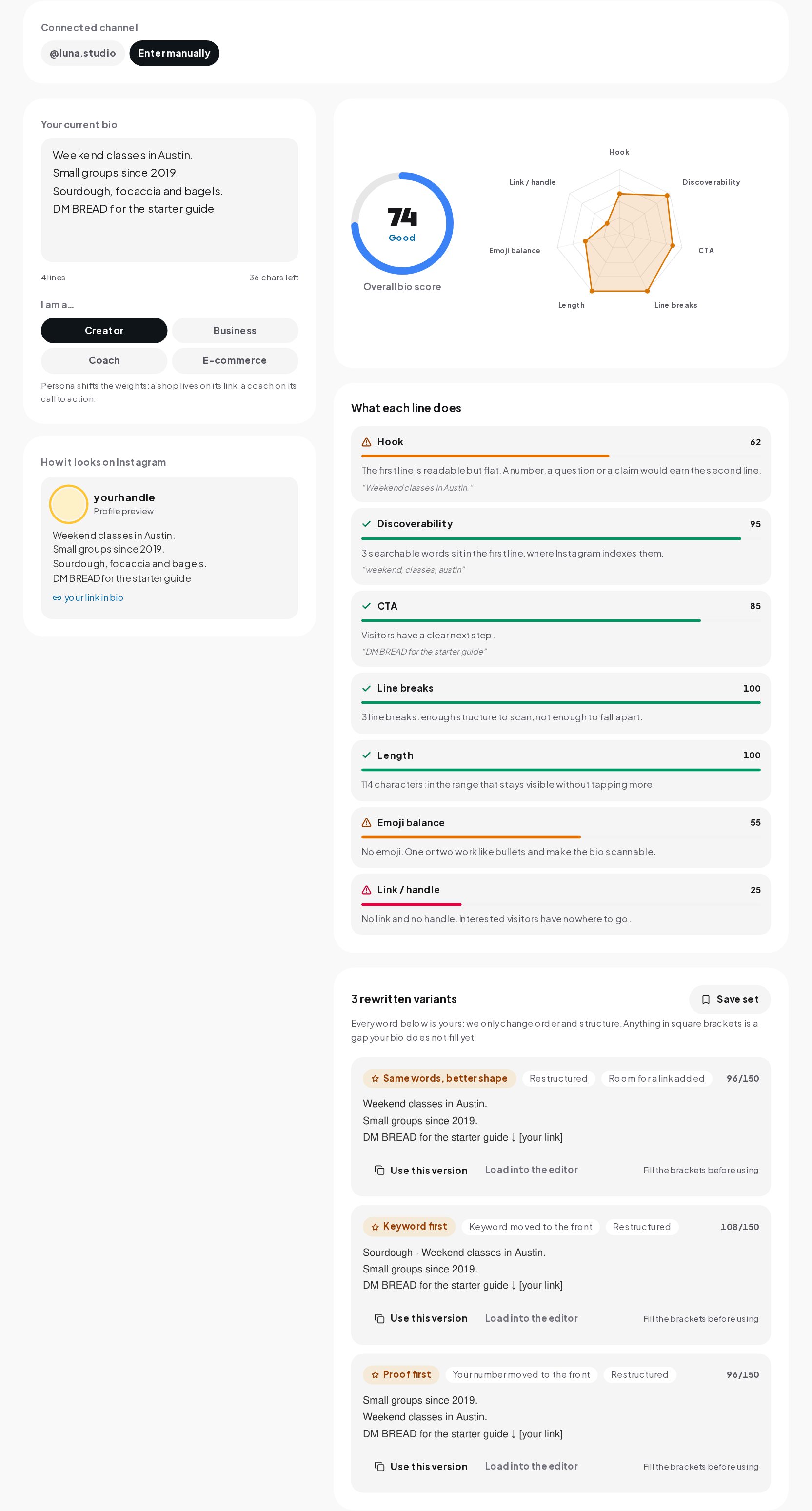
The Bio Optimizer scores a bio on the seven things visitors react to. Here they are with what good looks like.
| Check | What it looks at | What good looks like |
|---|---|---|
| Hook | The first line | Opens with a number, a clear claim or who you are |
| Searchable words | Content words in the first line | At least two words people would search for |
| Call to action | An action word such as DM, book, shop or tap | One clear next step, ideally with an arrow to the link |
| Line breaks | How the bio is split | Three or four short lines |
| Length | Characters | Roughly 70 to 145, never over 150 |
| Emoji | How many | One to three, used as signposts |
| Link | A URL or a handle | A real link to the page you want people on |
1. The hook
The first line is read by everyone; the rest only by people the first line convinced. The strongest openings start with a number or proof: "10 years teaching yoga", "Since 2019", "Ships in 48 hours". An emoji used as a signpost or an opening that names who you are ("I help...", "We bake...") also works. A plain line of a few words is acceptable. A long first line that runs past the space visitors read in one glance is the weakest.
Only use numbers that are true. Proof means something because it is real.
2. Searchable words
Visitors scan for the words that tell them whether you are for them: what you do, where, for whom. The optimizer picks out the distinctive content words in your bio and checks whether they sit in the first line. Two or more up front is strong. One is thin. Good words buried at the end are flagged, because they are doing no work there.
3. The call to action
A bio without a next step leaves visitors to work it out, and most will not. Action words such as DM, message, book, shop, order, join, download, apply, call, WhatsApp, tap or "link in bio" all count. The strongest version points at the link with an arrow, so the eye goes straight to it.
The best calls to action are specific. "DM me GUIDE for the free plan" gives a word to send and a reason to send it. "Contact me for more info" gives neither.
4. Line breaks
One block of 150 characters is hard to read on a phone. Three or four short lines, each with one idea, read in a glance: what you do, who it is for, proof, next step. A single break is better than none; five or more starts to look like a list.
5. Length
Too short and there is no room for the call to action or proof. Over 150 and Instagram cuts the end, which is usually where the call to action sits.
6. Emoji
One to three emoji, used as bullets or signposts, help a bio scan. None is fine but plain. Four or five is busy, and six or more reads as noise and pushes out words that would have helped.
7. The link
The link is where the bio pays off. A full link to your shop, booking page or lead magnet scores best. A handle of another account is a weaker substitute. No link means interested visitors have nowhere to go. Instagram lets you add several links to your profile; put the one that matters most first.
Who you are changes what matters
Not every account needs the same bio. The optimizer weighs the checks differently for four kinds of account:
| Account type | What matters most | Why |
|---|---|---|
| Creator | The hook | Visitors follow a person and a promise |
| Business | Searchable words and the link | People need to know what you sell and where |
| Coach | The call to action and searchable words | The goal is a conversation or a booking |
| Online shop | The link and the call to action | Every visit should end on a product page |
Pick the one that fits and the score and the rewrites follow it.
Three ways to rewrite a bio
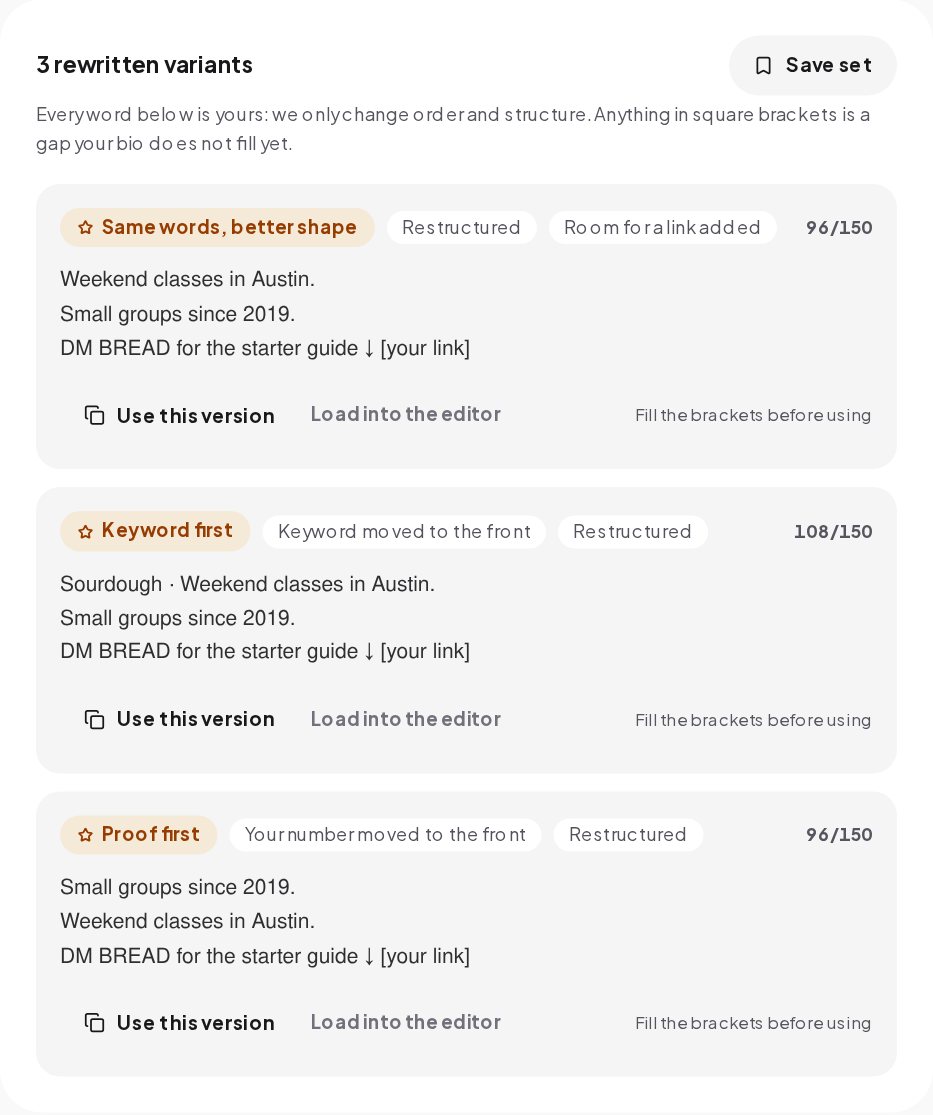
After the score, the optimizer rewrites your bio three ways, using your own words:
- Tightened. The same message in a clean structure: headline, who it is for, call to action pointing at the link.
- More searchable. The strongest keyword moves to the front of the first line, so visitors and search see it first.
- Proof first. The bio opens with the line that holds your proof, such as a year, a number or a result.
When a version needs something your bio does not have, such as a call to action or a link, it leaves a bracket for you to fill instead of inventing it. Nothing about your business is made up. Every rewrite stays within 150 characters, and when two versions come out the same, you see it once. A bio pasted as one line is read sentence by sentence, so each sentence can find its place.
Before and after
A weak bio:
It opens with a greeting, buries the topic, has no proof, no link and a call to action that asks for nothing specific.
A stronger version of the same account:
It says what, for whom and where in the first two lines, gives a specific next step and points at the link. Every word is from the original account's world; the bracket is where the real link goes.
Mistakes that cost you followers
- Opening with a greeting. "Welcome to my page" uses the most read line to say nothing.
- Listing everything you do. Pick the thing you want to be known for. A visitor will not read five roles separated by slashes.
- Styled fonts for keywords. Fancy Unicode letters look nice in a name but search does not match them to the plain word. The Instagram Font Generator explains where they help and where they hurt.
- A call to action with nothing behind it. "DM me for prices" only works if someone answers, quickly.
- A link that goes to your home page. Send people to the page that matches the promise in the bio.
Optimizing your bio in a minute
- Open the Bio Optimizer and paste your bio exactly as it is, emoji and line breaks included.
- Pick the kind of account: creator, business, coach or online shop.
- Read the score and the reason under each of the seven checks.
- Compare the three rewrites, fill any bracket and adjust the wording.
- Paste your favorite into Edit profile in Instagram, and put your main keyword in the name field too.
When the bio says "DM me"
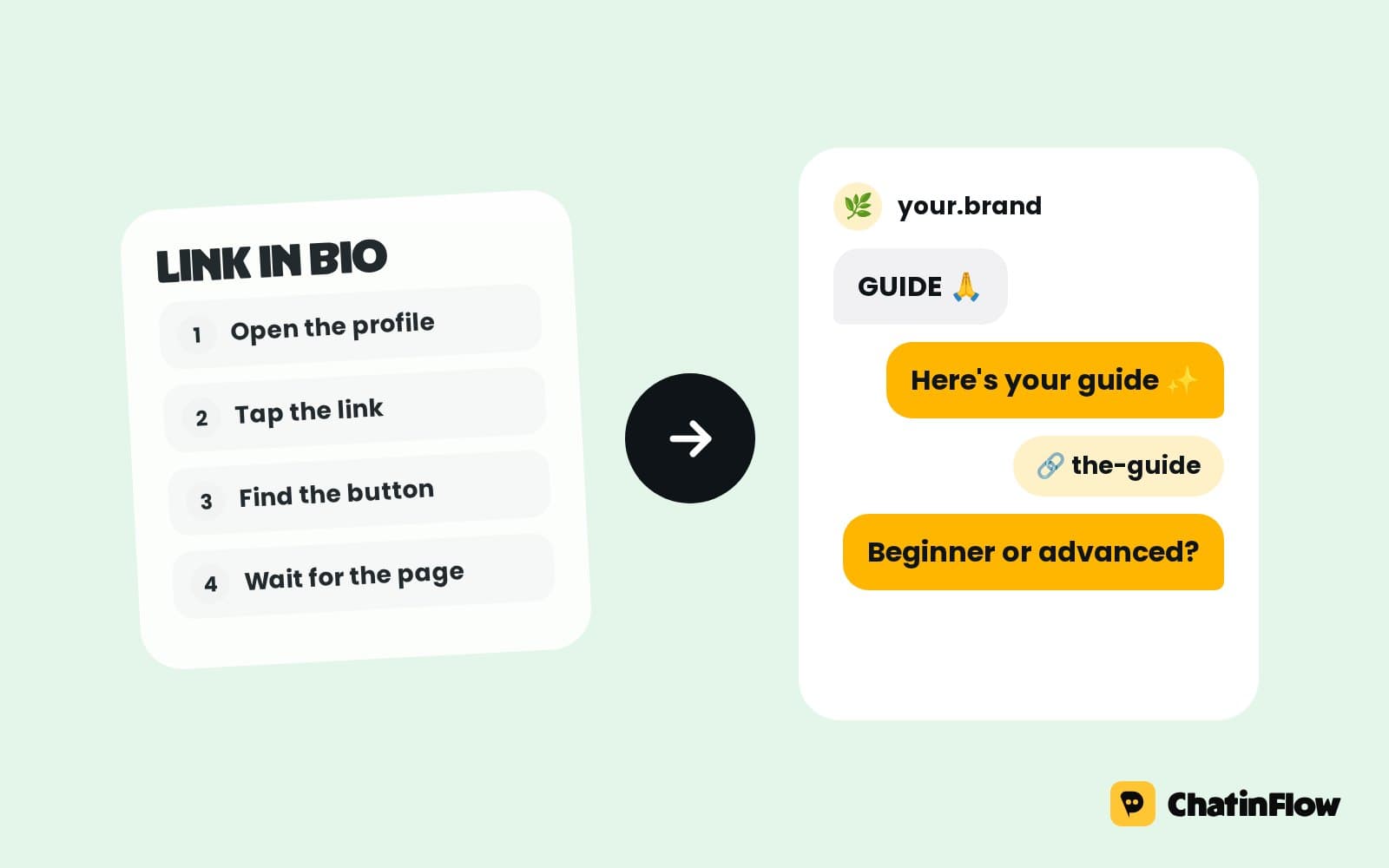
The best calls to action in a bio ask for a message: "DM me GUIDE", "DM BOOK for a slot". They work because they are easy, and they fail when the reply comes hours later. With keyword automations in ChatinFlow, the word in your bio gets an answer in seconds, day and night, with the guide, the link or the booking page. The bio makes the offer; the automation delivers it.
Quick answers
How long can an Instagram bio be?
150 characters, including spaces, emoji and line breaks.
What should I put in my Instagram bio?
What you do and for whom in the first line, proof if you have it, one clear call to action and a link to the page you want people on.
Should I use keywords in my Instagram bio?
Yes, in plain letters. Put the main one in your name field as well, because Instagram search matches names and usernames first.